The first public statement made by the university about the finding of the enslaved remains was almost two years after the 2015 discovery and two weeks before NPR published a report; it was also the same report that announced the reinterment ceremony would take place in four subsequent months and at a cemetery in town that was once historically segregated. At the reinterment ceremony, it was never mentioned that the lives buried beneath the building were once enslaved. Two prominent community leaders in Athens both repeatedly emphasized how they felt frustrated, disappointed, and outraged by the university’s response to the Baldwin Hall discovery because they felt that the university owned all the power in the commemorative events (personal communications). Specifically, they stated that all the actions taken by the university made them feel like they (as probable descendants of the discovered remains) were not allowed to give any input about the subsequent commemorations, even after they explicitly asked administrators if they could. Instead, the university determined the memorialization alone by hosting a depoliticized ceremony and secretly burying the remains in a mass grave weeks before the ceremony (Smith, Parry).
However, African Americans in Athens did not let this state-defined commemoration go uncontested. On May 4th, 2017, a collection of activist groups and community leaders marched around downtown Athens specifically under the agenda of protesting racial discrimination in Athens. Before the march, folks began by informally gathering on the steps of Baldwin Hall, and professors and community leaders placed a ceremonial wreath of flowers and a bowl-shaped urn inscribed with different West African Adinkra symbols with the date “May 4th, 1865.” This was the day Union soldiers freed all the enslaved people in Athens, remembered as the “Day of Jubilee.” A professor of African American studies poured liquid in the urn and performed a libation ceremony and other folks well integrated into the African American Athens community spoke, read poems, and sang songs in remembrance.
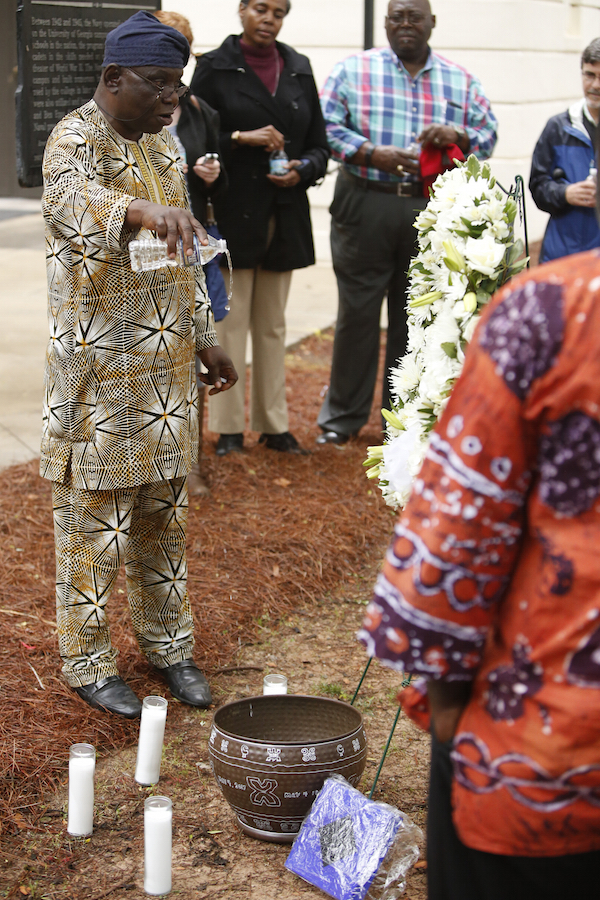
UGA Professor Ibigbolade Aderibigbe pouring water in Libation Urn for ceremony outside of Baldwin Hall at UGA.
Khoury, Kat. “Athens Celebrates the Day of Jubilee, When Local Slaves Were Freed.” Flagpole
[Athens, GA]. 5 May, 2017. (see source here).
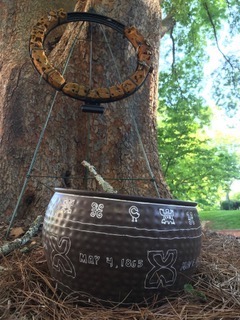
Libation Urn placed by African American protestors on the Day of Jubilee event on May 4, 2017. Photo taken by Laura Brannan, 2017.
This strategy of protesting on a historic day utilizing objects like the urn, with its inscription of the date of the Day of Jubilee with the West African Adinkra markings symbolizing strength, courage, and freedom, embodies the nuanced agency of Athens’ Black population and those pushing back against the ways the university excluded community input into the official memorialization process. It also embodies Nicholas Mirzoeff’s theory of “countervisuality,” the act of countering or opposing the authoritative power of visuality, which “tells us to move on, [and is] the exclusive claim to be able to look” (2011, 2). Visuality can be actual visuals or a “discursive practice that has material effects” (3). Visuality is seen as discourse in the case of UGA through university admins defining, deciding, and owning the official commemorative events – they are the authoritative voice commanding the public when to look and when to not, and more importantly when to move on.
However, the Day of Jubilee protest and the memorial intentionally and successfully move against UGA’s hegemonic visuality by explicitly connecting the current marginalization faced by African Americans today in Athens as a direct result from the history of slavery. The viewer cannot help but notice the urn and wreath at the entrance of Baldwin Hall, as it is anomalous from typical monuments made to look naturally part of its surroundings. The libation urn disrupts the everyday, quotidian, forgetting of slavery and enslaved people. It demands you to look and remember the history of slavery, telling you not to move on but perhaps that at this juncture and in this context we cannot move on. We must simply sit in the silence - though it begs the question of what other racial silences are at play in the space of UGA.